Saturday, August 14, 2010

A pictures worth a thousand words

To be able to touch a miraculous work of my ancestors was life changing.
Climbing the Rock Tombs of Elephantine Island . Sam, James Robinson, and Breyiana Moody.
Playing rope with the children of the nubian villiage. - Breyiana Moody
In awe - Breyiana Moody
The way in which the Ancient Egyptians used natural light within the temples is absolutely amazing. -Breyiana Moody

You Think You Know...But You Have NO Idea

..................................*sigh and deep breaths* I apologize for beginning this entry so unusually but after the class we just had....at this current moment that is all I can do. In fact, I do not apologize because that would give the implication that something wrong has been done ensuing a feeling of possible regret, which is not the case. There are so many words to describe today’s full day class session, but at the same time there are no words sufficiently expressive enough to describe it.


For almost two weeks now, we have traveled together, taught and learned from one another, lived together, and experienced something most of our people may never get to experience first hand together. With all this time that we have spent together getting to know one another, we probably know each other better than our closest friends; but at the same time you can know everything about a person and still know nothing about them. This was discovered today as my various peers and elders reflected about the trip and the connections and impacts it has made to and in their personal lives. As many people shared their thoughts and reflections, it was obvious that a certain feeling of familial trust had been established amongst us. It was this connectedness of such where if the person cried, you cried; the person laughed, you laughed; the person got angry, you got angry. The entire situation reminds me of the song “I Cry” by Ja Rule featuring Lil Mo. “When I cry, you cry, we cry together.” I was humbled by the entire class because it was finally clear that everyone understands why we came here. Everyone if not completely cognizant is at least aware of our memory dismemberment and can now work towards re-membering it.


Today’s class let you know that there were other people [there] with you. There are other people who have/are going through what you have/are going through or worse. This entire trip if nothing else has established this fact: there are people like you. There are countless times on this trip that people looked at the sculptures and figures on the walls of temples and had the epiphany: “That’s me. I look like that. Those are my lips and my nose.” For any black person who felt as if they did not belong or were not good enough to accomplish greatness or exceed such, that theory was and should have been completely decimated and shot to hell with whatever/whoever made you feel as such when you are re-minded of what your ancestors, the Africans, the Egyptians accomplished. They created EVERYTHING from NOTHING; as we will when we go back “home” to share with our family and friends what we have learned. They think they know.....but they have no idea.

Friday, August 13, 2010

It's All In the Stars

Today’s wake up call is 5:30am for our three hour drive to Abydos.  By now, I think everyone is used to the earlier wake up calls and driving long distances for hours.  This just means one thing to us: NAP TIME!!  

Abydos, although mostly buried,  spreads over five square miles and is composed of archaeological remains from all phases of Kemetic civilization.  It is the original center for Wosir (Osiris) and is most famous for its seven Holy of Holies dedicated to Sety I, Ptah, Re-Horakhty, Amun-Re, Wosir (Osiris), Auset (Isis), and Heru (Horus).   There is a back gateway oriented to the site of the old royal cemetery at Umm el-Gaab. The most distinctive and memorable pictures on the wall were the ones illustrating the myth of Osiris.  In this myth, Isis and her sister, Nephthys find Osiris after he was killed by Seth.  His death is not erased nor undone, but integrated into Maat (the divine order of the world). Osiris is awakened from his slumber and through transfiguration, Isis is able to impregnate herself by him, in order to conceive a son, who will avenge his father’s death.  The beauty of Abydos is seen through its imagery, which depicts more intimacy and affection between humanity than previously seen at other sites.  We also got to see the archaeological site of where it is thought Osiris to be buried.

The second stop of the day was to Dendera.  Dendera is the temple for Het Heru, also known as Hathor, the personification of love, motherhood, fertility, music, and dance.  She is represented with cow ears.  The thirty-four columns of the temple are headed with four sided heads of the cow goddess adding the spectacularity of the already amazing art on the walls and ceilings, which show off the extreme extent of the Egyptians knowledge of the sun, stars, and universe.  The ceilings illustrated their discovery of what we know today as horoscopes and how they measured time based on just studying the stars. AMAZING? INCREDIBLE? UNFATHOMABLE? UNBELIEVABLE? I know.  I gave up trying to find words to describe the works of the Egyptians a long time ago..........last week.

With A Full Heart

The whole time we have been in Egypt a real bond has grown between all of us. We have come a long way from the first day in JFK airport when we hardly knew anyone. Through our daily lectures, I have really gained so much insight on African civilizations and also the lives that African Americans are living right now through testimonies that were given.

During lectures, I don’t speak out like some others. I prefer to sit back and absorb everything that is said. The room sometimes gets filled with so much emotion. On Friday in particular, we opened the session with a brief talk by Mr. Clarence Jones on his blog entry. After he spoke, the floor was opened for reflections. It seemed that after about 30 seconds of looking around to see who would say something, the floodgates opened. Several people started to get up and share their experience and reflections on this trip.

To give a more well rounded expression, many people drew from their past life experiences. Moments like that really give you insight into people’s lives and what they have been through. I applaud all of my classmates who have been through storms in their lives and are still making great things happen everyday. I was shocked by the struggles they described and I struggled to place myself in their shoes. In that moment, I gained a new appreciation for everyone in the room. I can honestly say, you can never judge a book by the cover.

Thursday, August 12, 2010


Michelle Ricks in front of Ramses the Great

Het-Heru (Greek name Hathor), literally translate into the house of Heru. She is his wife-consort and she is also the goddess of beauty, love & feminine fertility. The Greeks would later take a tangent slant on her and rename her Aphrodite. The Romans would name her Venus. The complexity in the relationship between her & Heru wouldn't transliterate in the Greek comosology.

Doc at one of Ramses' stelae in the first capital of Kemet, Mn Nfr. What the Greeks would later call Memphis.

Dr. Mario Beatty with other Chicago State colleagues with the backdrop of the Great Pyramids in the El Meriden.

Jalil Mohammed, James Morgan & myself at the Cairo airport after we had all landed.

Rebels With a Cause


Rise and shine at 4:30 this morning!!! It was all part of the plan to beat Re at his own game. First stop of the day was the colossi of Amenhotep III. These were the statues of Amenhotep III & Queen Tiye.It was a little difficult to tell because their faces were pretty much gone due to time.


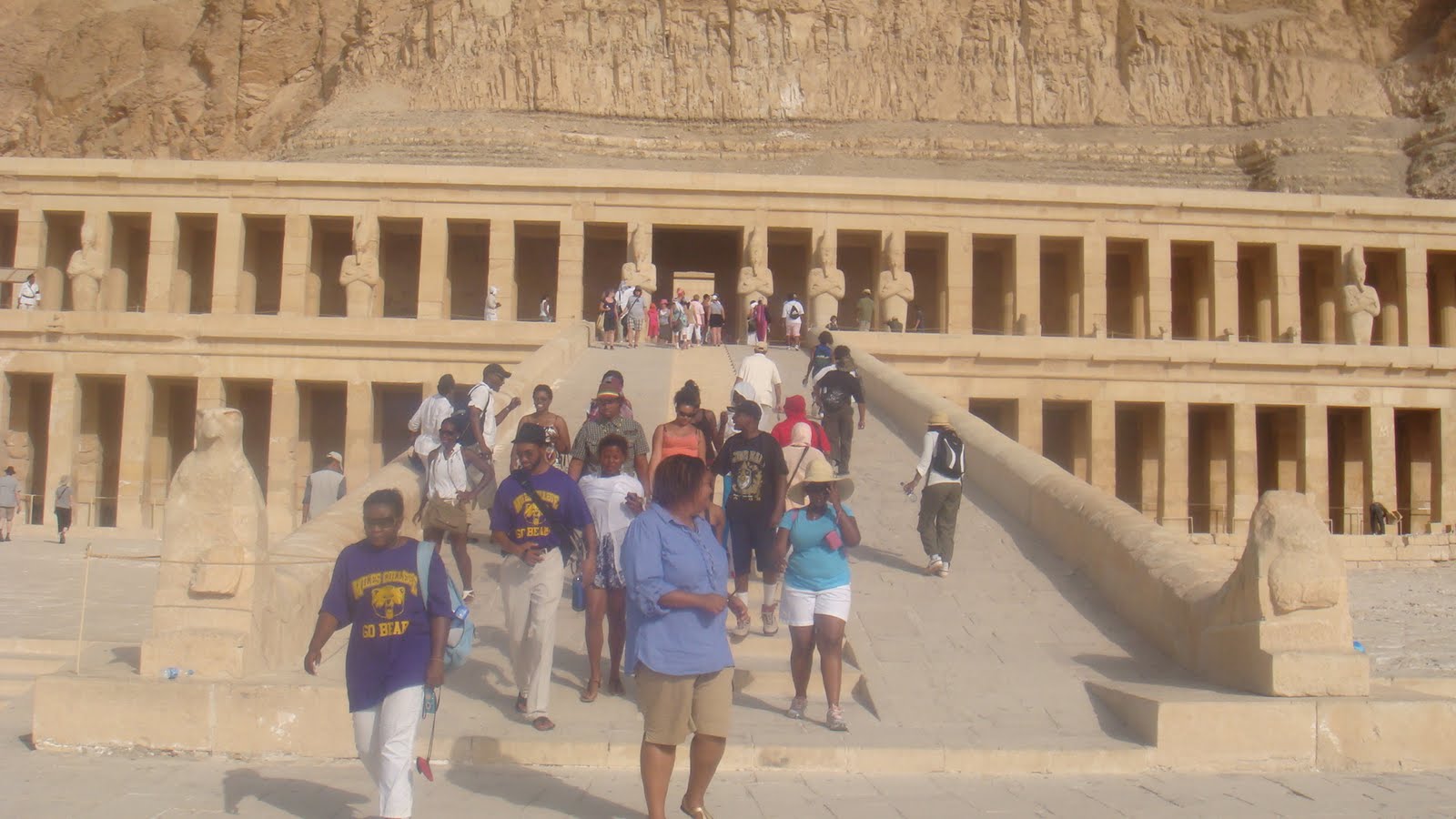
Hatshepsut’s temple at Deir El-Bahri designed by Senenmut was the next stop of the day. I find her accomplishments as pharaoh during her reign to be incredulous. This is especially because there was no female who had ever taken the reigns of what was known to be a man’s job at that time. Her temple was an example of how they tried to erase her out of history by scratching her out of most of the wall drawings.


Next, it is what I have been waiting for since the Cairo Museum- the Valley of the Kings!!! We went into King Tut’s tomb, Ramases III’s, Thutmosis II’s, and Ramases IX’s.

Seeing King Tut’s tomb really did not help in giving me a viable explanation to where all the treasures we saw at the Cairo Museum were originally found. In fact, it added to my disbelief. The tomb is way to small to fit everything we saw at the museum, but unfathomably it did. We also saw King Tut’s mummy itself. It had to be taken out of the coffin and placed in a glass case because it was too weak to be moved. This is due to Howard Carter, who uncovered the tomb. It took him ten years to find it and five years to take all the treasures out. In the process of doing this he searched Tut’s mummy for pieces of gold, amulets, and other jewelry, resulting in the further weakening of the body.

Ramases III’s tomb was a little more complex than Tut’s and it was definitely bigger. The key thing about his tomb was that it depicted the table of races and therefore delineated how the Egyptians viewed themselves in comparison to the rest of the world. Did they consider themselves to be African? According to the pictures on the wall, they sure did!! Also, on both walls on either side of the tomb when you first walk in you see his declaration of innocence, which was a written depiction of his character-another key aspect of his tomb.

Thutmosis III’s tomb was unnecessarily overly complex. Before you even go into his tomb, you have to climb some very steep stairs that lead into a mountain. Then to enter his tomb, you go down another flight of stairs that were also steep which lead you to one room which connects the last room with a very small, steep staircase that is perfect for those who are vertically challenged. The last room has a coffin and hieroglyphs filled the walls in both rooms. These hieroglyphs were questionable in my eyes because they were unlike the other previous paintings on the walls we have seen. They looked primitive and unlike what we normally expect from the Egyptians. It seemed they were drawn with a Sharpie marker and they were stick figures. Dr. Carr’s explanation of this is these were earlier works that date back to the 1500’s and 1400’s.

Ramases IX’s tomb structure was pretty simple. This is probably due to the fact that it was unfinished. The last stops of the day were the worker’s village for the workers of Deir Al-Bahari Temple and Ra-Moses’ tomb. It is hard to believe the village was even a a real village at some point that housed 400 workers.

The biggest issue of the the day was the limitation on our ability to take pictures inside the tombs. Most of the day we were instructed to leave our cameras on the bus. Now if we really want to take pictures, we are going to find a way. We are African. It is in our blood to resist, esp. those limitations imposed on us that have no business being imposed. If you do not believe me, look at slavery. There were a couple of incidents where security tried to hold us down, figuratively. The first incident was in King Tut’s tomb where the “security guard" (I use that term loosely) clearly took 20 pounds ($4.00 U.S.) from a white man and allowed him to take a picture or two but literally got in our face at the slightest sound or hint of light. The other incident occurred at Ramases IX’s tomb where yet again one of my peers was accused of taking pictures. This time the “security” confiscated his phone and took him to the head of their joke of a department. As usual, Dr. Carr did what he does best and handled the situation. The point of the matter is that these incidents should have never occurred in the first place because these people have no right to restrict us from any means we take to feel close to our people. They are making a business on the backs of our ancestors which is just so disrespectful. But, I bet you are wondering if we really did commit these crimes we were accused of. Well, I will let you come to your own conclusion on the topic. All I suggest is that you keep in mind that we are African.

Real Recognize Real


Many of my fellow travelers have expressed a certain level of discomfort since our arrival in Luxor as have I. Some of the things that I have witnessed and been a victim of are the same racial double standards we find perverting American society on a usual basis. Today, I admit I lied to a vendor to test his seemingly sincere demeanor. He approached me and a female student and asked where we were from, obviously expecting us to say America or some other Western nation. When I replied "Ghana" he immediately lost all interest in trying to make a sale to us. It is quite ironic that even though we are in Africa in some ways due to the high Arab population and the Islamic tone of the country, we are not in Africa...... if that makes any sense.

Yesterday, however there was a very interesting thing that happened while we were at the Luxor Temple. Our group ran into a group of young people from the Congo and a group of you men and myself locked eyes as though we were distant relatives (which we are) and immediately embraced one another. At the time we did not know if we even spoke the same language (we did) but all we knew was we saw some familiar faces in a land that has been for centuries occupied by foreigners even though it naturally belongs to us. The Asian and Caucasian tourists walking around probably didn't notice as some of them were crazily walking around a statue of Kheper-ra in a circle because of some old wives tale that it will grant them a wish. However had I made a wish it would have only been for that which I received. A subtle reminder that although Kemet is now largely in the hands of outsiders and visited by people who truly only come for the novelty of it at the heart of it all was once the idea of African men and women like us who wondered what was beyond the rocky patches of the Nile, that we now call the the cataracts. As we departed and exchanged Facebook information one of the Congolese Brothers repeated an oft spoken phrase that we use in Urban America..... "Real Recognize Real"...... That experience yesterday proved it to me.

Wednesday, August 11, 2010

The White Chapel, The Black College & The Divine African Legacy

Today we went to the Temples of Karnak and Luxor and in an experience that has become a staple of our trip we found ourselves off of the beaten path and going to visit the White Chapel which was built by Senwosret I. This has probably been one of the most humbling academic experiences in my life because of the fact that this place is known in some circles as the worlds first University. As Dr. Carr and Dr. Beatty performed a libation for their late mentor Dr. Jacob Carruthers I thought about all of the students who passed through this small chapel building where they learned the sciences of Astronomy and Theology and how they were not separated but fuzed and understood as one sacred science that itself was a rule and guide for their daily lives. Now I and and the rest of our entourage were passing through these same halls being instructed by Master Teachers in an unbroken line of academic and social excellence. I truly wonder if we at Howard University are aware of this legacy when we make decisions that not only impact our campus in Washington D.C. but on a wider scale the world. I couldn't help but sit down as the libation was being performed not so much on account of my own physical fatigue but more so because of the humbling experience of being in that Divine African Legacy

It seemed like poetic irony as we walked through the temple of Luxor and we were told that this entire temple complex was once buried under sand and rubble and an entire town was on top of it before it was excavated. In fact there is a mosque building that is now out of service but was build on top of one of the structures unknowingly and is still there. As I looked at this image I thought of all the Muslim men, women and children who lived there lives not knowing of the 100% African tradition that was right under their now non-existent town. A similar thing could be said of Washington D.C. as many people know it was built on Kemetic archetypes but few Americans are aware of this. Today more than any other day I realized the importance of my attendance at a historically Black college.

As we Pursue Change

As we begin our journey to Ancient Kemet, I was unsure of what laid ahead. After 6 days of site visits, lectures and readings, covering centuries upon centuries of rich history, I could only begin to attempt to absorb it all. How could I go back to my family, university, and nation with this abundance of new knowledge and pour the truth back into the masses. I finally stumbled upon the something that was in front of me for weeks. In our travel packets /reading there is the Teaching of Ptah Hotep. Which reads,

“Don’t be proud of your knowledge. Take counsel with the ignorant as well as the wise.” . . . .Good discourse is more hidden than green stone, yet may be found among the maids at the grindstones. “

Coupled with the corresponding lecture I learned that Ptah Hotep strongly lived by the concept of the Medu. The Medu stood for the staff of old age, something sturdy to pass on to the next generation. Basically the strength of a legacy: if you pass on this truth, this truth will make the next generation live, therefore battling against the fear and reality of non-existence.

While reading this material and learning about the Medu I was reminded of a poem I once learned, which could aid me in the way in which I could create My MEDU, or strong legacy by passing on the truth.

“When I was a young man, I wanted to change the world. I found it was difficult to change the world, so I tried to change my nation. When I found I couldn't change the nation, I began to focus on my town. I couldn't change the town and as an older man, I tried to change my family. Now, as an old man, I realize the only thing I can change is myself, and suddenly I realize that if long ago I had changed myself, I could have made an impact on my family. My family and I could have made an impact on our town. Their impact could have changed the nation and I could indeed have changed the world.”


Early Pics......


Ramesses II @ Memphis

Ramesses II @ Memphis

Stelae of Ramesses II

Great Pyramids in the distance

Reflections: A Spiritual Journey to Kemet

Hotep my brothers and sisters.


Although our visit to Kemet has included stops at numerous iconic sites, such as the Pyramids at Giza, the royal mummy hall in the Cairo Museum, the Philae Temple near Aswan and Ramses’ II temple monuments at Abu Simbel, the objective of our journey has a greater purpose beyond sightseeing. For me, this has been a spiritual voyage that is God inspired. This is truly an experience of a lifetime. I have so much to share about the journey to Kemet.


This journey has been the medicine to further rejuvenate my mind, body and soul. In addition, the acquisition of knowledge of the contribution that our ancestors made to mankind is another primary objective. This objective has been more than adequately addressed by our illustrious co-lectures; Dr. Greg Carr and Dr. Mario Beattie. I thank both of them for their commitment to this effort.


After some reflection and enlightenment of my sacred purpose as one of the elders on this trek to Kemet, I come before you on the eve of a day that is of some personal significance; my 62nd birthday. My thoughts emerge from a deep inner urge to give praise to my Rock, Redeemer, Lord and Savior, Jesus Christ. I lift Him up. I also seek to convey a brief autobiographical Sebayet, which will include a few words of wisdom, which is meant to inspire members of my Howard University family and other interested readers and listeners.


Such expression is consistent with the Instructions of Ptah- Hotep, which is the most ancient complete literary work existing. It was written in the Fifth Egyptian Dynasty, 3580 B.C. to 3536 B.C. In this papyrus book, Ptah-Hotep sets down the rules of behavior that all wise men should convey to their sons. It consists of 37 maxims framed by a prologue and an epilogue. One of the maxims reads as follows:


  • May this servant be ordered to make a staff of old age, So as to tell him the words of those who heard, the ways of the ancestors, Who have listened to the gods.


  • May such be done for you, So that strife may be banned from the people, And the Two Shores may serve you!


  • Said the majesty of this god: Instruct him then in the sayings of the past, May he become a model for the children of the great, May obedience enter him, And the devotion to him who speaks to him, No one is born wise.

    Therefore, consistent with the Instructions of Ptah-Hotep, I offer the following testimony (my staff of old age) for those who are inclined to hear.

My journey of sixty-two years has taught me the value of faith. For without faith in God we are like wheat blowing in a storm; without purpose or direction. It is written in Hebrews 11:1 that, “…faith is the substance of things hoped for, the evidence of things not seen.”Over the course of my life, I have learned that through focused pray God reveals the evidence of His truth and mercy. This is done in His own time and serves to confirm the validity of our faith in His presents.


The Early Years
My mother once told me that oftentimes, God brings us to our knees to bring us closer to Him. Early in my life, the death of my father was a life altering experience that tested my faith. I was 16 years old and I searched for answers. Why did he leave me, my mother and siblings so early? How could I go on without his love, support and guidance? It was during those quiet times on my knees in prayer, during the reading of His Word or during the mid-night hour in the midst of a deep slumber that God began to reveal His purpose. Scripture teaches us that our Father in heaven will never forsake or leave us. Joshua 1:5 says, “…As I was with Moses, so I will be with you; I will never leave you nor forsake you.” I was in search for some explanation, justification or understanding for how to go on without my father. However, the answer to my second question is found in Proverb 3:5, which reads, “Trust in the LORD with all your heart and lean not on your own understanding.”


Young Adulthood
Late one evening while on guard duty in the Republic of Vietnam at the age of twenty-one, I again was presented with a situation that tested my faith. The siren when off and I scrambled to get my gear together. Within two or three minutes, I heard the sound of a 122 millimeter enemy rocket whirling over my head. Momentarily, I froze in a state of panic and fear. Mercifully, I reached into my pocket and pulled out a small bible, a gift from my mother. I turned to Psalm 23, which reads, “…Yeah, though I walk through the valley of the shadow of death, I fear no evil: for thou art with me…” I read it twice and I was instantly returned to calm because I knew that He was in control. It was as if I heard him whisper, “Peace be still” (Peace, be still. And the wind ceased, and there was a great calm, Mark 4:39).


This episode in my life reminds me of Ramses II (ruler of Kemet from 1304 BC to 1237 BC) during The Battle of Kadesh, which was the decisive war between the Egyptians and the Hittites for control over Syria. It took place in the spring of the fifth year of the reign of Ramses II. Like me, Ramses II found himself in mortal danger. Accordingly, he makes a plea to his god, Amun, which was a god in Egyptian mythology that in the form of Amun-Ra became the focus of the most complex system of theology in Ancient Egypt. His position as King of Gods developed to the point of virtual monotheism where other gods became manifestations of him. With Osiris, Amun-Ra is the most widely recorded of the Egyptian Gods. The following is synopsis of Ramses’ II partition to Amun-Ra during the Battle of Kadesh:


Here I stand, All alone; There is no one at my side, My warriors and chariots a feared, Have deserted me, none heard My voice, when to the cravens I, their king, for succor, cried. But I find that Amun's grace Is better far to me Than a million fighting men and ten thousand chariots be. Yea, better than ten thousand, be they brother, be they son, When with hearts that beat like one, Together for to help me they are gathered in one place. The might of men is nothing, it is Amun who is lord, What has happened here to me is according to your word, And I will not now transgress your command; But alone, as here I stand, To you my cry I send, Unto earth's extremest end, Saying, 'Help me, father Amun, against the Hittite horde."'


It is important to note that in the three religions of Judaism, Christianity and Islam, whenever the faithful pray, regardless of language, they always end their prayer by saying Amen. There is no linguistic translation for Amen, because it is a name and not a word. The origin of Amen is Egyptian, for Amen was taken from the name of Amun-Ra. The Jews have learned about Amen during their sojourn in Egypt, which lasted for four generations. The name of Amun, which means the Hidden One, in Ancient Egypt, lives on.


Latter Years
In January 2007, I was diagnosed with pancreatic cancer. I have one chance for a cure. The doctor explained that the Whipple procedure was a twelve hour surgical operation that is fraught with the risk of fatal consequences. The Whipple procedure surgery is a complicated process that requires a great deal of skill to perform. I often refer to this has a reengineering of my digestive system.


However, this operation was the best hope for complete eradication of the cancer that was wrecking havoc on my pancreas. With only one day notice, I began preparation for this uncertain outcome. On the night before the operation, I organized my financial, legal, and other matters and spent many quiet hours alone in pray. In addition, I organized the things that I would take with me to the hospital. The obvious items including a tooth brush and tooth paste, slippers and pajamas were packed. Other important items included my cell phone, which included my contact directory and music files with an attachable speaker system.The next morning, I arrived at the Howard University Hospital early. The twelve hour surgery was completed without incident. After, spending several hours in the recovery room, I was wheeled to the intensive care unit (ICU). During the first night in the ICU the pain was immense.


Songs of Praise
The combination of pray, morphine and songs of praise got me through one of the most difficult evenings of my life. Thanks to my cell phone and handy dandy mini- speaker system, I was comforted with songs of praise and worship all night long. Examples include Yolanda Adams’ “The Battle is the Lord’s”, Richard Smallwood’s “Angels, ” and “Changed”, by Tramine Hawkins to name a few. As many of you know, Richard Smallwood is a Howard University alumnus. The lyrics from his song “Angles” have special meaning. In part, he says, “unseen hands guide me through the pain and darkness. Yes, angles are watching over me.”


Ironically, ancient Egyptians regarded Amun-Ra as the “hidden one”, which the ancient Egyptians prayed to in the time of trouble. This seems to be more than just an ironic coincidence to Smallwood’s lyrics. The next morning the nurses stated that the praise and worship service through song that I conducted all night long was a blessing to them.


I was present at Walter Hawkins’ last concert in April 2010, which was held at the Kennedy Center in Washington, DC. This was Bishop Hawkins’ last public performance prior to succumbing to a two year battle against pancreatic cancer. His words and songs of praise and worship still ring in my ears. He shared his battle with the audience and told us that God is in the business of performing marvels. He thanked God for allowing him to live. I thank God for Bishop Hawkins’ legacy of songs of praise, faith and worship. Some of my favorite songs include Marvelous, Going Up Yonder, Be Grateful, Never Alone, and When the Battle is Over.


Epilogue

My prayer is simple; Thy will be done. This has become a litmus test for the balance of my journey. I had to turn it over to Him and trust that it would be alright. Because like songstress Yolanda Adams’ said the Battle is the Lord’s. There is power in turning it over. Hallelujah!


The doctors said that my recovery might take six months. Through the grace of God I was back to light duty at work in six weeks. During the time at home I prayed, shouted and worshipped Him unceasingly. I thanked Him not only for what He had done but for what He was going to do.


More than a year after the surgery I was leaving a meeting and one of my Howard University co-workers stopped me to inquiry about my health. I indicated that I was doing fine. He mentioned that I helped him to renew his faith. In amazement, I asked him how this was so. He said it was because of what I said to him during a visit he made to my hospital room. I asked, what did I say? He stated that I said that I knew that there were Angels watching over me (undoubtedly my ancient ancestors, my father and mother, and a host of others). He then said that he could see the peace and calm in my face. Moreover, a year later he was a witness to my marvelous recovery.


It has been more than three and a half years since my diagnosis. The statistics suggest that the survival rate beyond five years is around five percent. The doctors and nurses all marveled at my recovery. Some called it a miracle. But, I know that Jesus is the marvel worker and I am just the vessel. It is with gratitude that I thank the nurses and doctors at Howard University Hospital.

A note of special is extended to my surgeon, Dr. Wayne Frederick, a gifted prodigy that journeyed from his home in Trinidad at the age of 16 to begin his undergraduate education at Howard University. He then went on to graduate from Howard’s medical school. He is a talented Surgical Oncologist and acting director of Howard University’s Cancer Center. Dr. Frederick is the protégé of the legendary Dr. LaSalle Leffall, who is currently the Charles R. Drew Professor of Surgery at Howard University Hospital. It is noteworthy that Dr. Leffall was trained by the iconic Dr. Charles Drew, a legendary pioneer in the field of blood transfusion. I thank God for the skill, dedication, and compassion of these exemplars of medical excellence. Their work is consistent with the spirit of Imhotep (2655-2600 BC) who was one of the world's most famous ancients from Kemet and is often recognized as the world's first doctor, a priest, scribe, sage, poet, astrologer, and a vizier and chief minister. Imhotep is considered the father of medicine. In fact, Dr. Eric Anthony Joseph, a scholar from Lincoln University asserts the following:


When the Egyptians crossed the Mediterranean Sea, becoming the foundation of the Greek culture, Imhotep's teachings were absorbed and sampled there. Yet, as the modern Greeks were determined to assert that they were the originators of almost everything, Imhotep was forgotten for thousands of years. In his place the legendary figure Hippocrates, who came 2,000 years after Imhotep, became known "incorrectly" as the "Father of Medicine."


This falsehood is so woven into the pedagogical fabric of western higher learning that upon graduation from western medical schools students must or will take this erroneous and rightly called "Hippocratic" oath! What a hypocrisy made by my so-called learned scholars who continue to perpetrate this known "lie" to the next generation of physicians


In conclusion, although the journey is not over, I have learned that faith and grace are enduring dimensions of a God-center life. Five themes emerge that are critical to staying on course. These include:


  • The power of prayer


  • Reading His Word


  • Turning it over to Him


  • Songs of Praise


  • Unwavering Faith in His Divinity


The most important of these is Faith. Hebrew 11:6 says, Without faith it is impossible to please God, because anyone who comes to Him must believe that he exists and that He rewards those who earnestly seek Him.”


Praise the Lord my Rock, Redeemer, Lord and Savior, Jesus Christ. I lift Him up. Hallelujah! Hallelujah! Amen.


Yours in the spirit of Ma’at (truth, balance, order, law, morality, and justice.)


Clarence Jones, CPA

Living Large


The Karnak Temple is the most important and archaeological site in Kemet. It is the largest temple complex ever constructed with Amun as the central figure of the temple and is referred to as Ipet Resyt (the southern private chambers). The prominent local divinities of Karnak were Montu and Amun. We saw the sandstone columns and still painted ceilings of Hypostle Hall, the Kiosk of Taharqa, Hatshepsut’s obelisk, the Sacred Lake, and the Festival Temple of Djehutymes III. One of the most impressive things I found about the Karnak Temple besides the fact that it took about 31 people to make a full circle around one of the columns, was the sphinx-lined processional way that stretched to the Luxor Temple.


As usual, in order to further enhance our general knowledge, we took a detour to the White Chapel. The White Chapel was built by Senwosret I and is also known as the world’s first university. The beautiful and tragic thing about the White Chapel is that many people are unaware of its existence. Because of this, they are missing out on the legacy and history. It is in this quaint, little building that students learned astronomy and theology and how they are but one science rather than two which is used as direction for their daily lives. At this temple, I was blessed with an out of body experience as Dr. Carr performed a libation. There is nothing that can compare to or describe the thoughts and feelings I had that makes me even more thankful and appreciative of having the opportunity to have this experience.


The Luxor Temple is dedicated to Amun Re. It is referred to as the southern Opet (place of seclusion). At this temple, we got to see first hand the greatest example of these modern day crooks participating in one of their favorite activities-restoration of the temple. (ie. the desecration of the original work in attempts to make it look pretty and the way it might have originally looked in the ancient times.) Personally, I do not see why they find restoration to be necessary because it takes away from the natural, personal affect the original Egyptian works give. In my opinion, they should be allowed to age without interruption.


Brother James


James & I showing some brotherhood at Karnak

Arrival in Waset (Thebes): The Power and the Most Select of Places


We have arrived at the world's largest temple complex of the classical era, the nearly two mile stretch of buildings known as Ipet Isut (Karnak to the Greeks) and Southern Opet (Luxor Temple). The collective area, which covers both sides of the Nile and includes the Valley of the Kings and Queens, was called Waset ("The Scepter of Power") by the Ancients and Thebes by the Greeks. Here, Kemet centered the marriage of governance structure, spiritual philosophy, scientific inquiry and artistic expression, beginning in predynastic times and stretching across the entire unbroken three millennium life of the nation. Traveling here by bus from Aswan yesterday, we stopped at two of the most important temple sites of the Late Period, the massive double temple complex dedicated to Sobek and Haroeris at Kom Ombo and the imposing Temple to Heru (Horus) at Edfu, the largest temple remaining from classical Kemet (note the scale in the picture above: we are standing next to one of the figures of Heru as a falcon that appears so tiny in the picture of the temple pylons).

At Kom Ombo, we considered the significance of the double "holy of holies," examined the temple's "per medjat" (library, or literally "house of books"), its "per ankh" ("house of life," where scribal instruction was carried out) and the stunning display of medical instruments and techniques, including various scalpels, forceps, sponges, mortars and cupping vessels that link the practice of medicine from the 2700 b.c. era of Imhotep (who the Greek swore to as Asclepius in the Hypocratic Oath) through the age of Greek and Roman study under Kemetic tutelage in the third century b.c.e.

At Edfu, we explored the remarkable recitation in stone of the "Battle of Heru and Set," a central narrative of testing one's character in the face of the ultimate adversity that lies near the center of Kemetic cosmology. The night before, our last in the idyllic surroundings of Aswan, the gateway to Nubia in classical and contemporary times, we reviewed the implications of African concepts of character, from the Kemetic through the Yoruba idea of "iwa rere" to contemporary moorings in African-Centered psychology.

Our nightly class sessions have reached a watershed of intensity as our students have begun to grasp a basic familiarity with elements of Kemetic language. Today, we will examine the implications of a national building project that, like the pyramid age, was designed to bond the entire population to a common purpose and resonant social meaning: the elevation of the Divine as a first order organizing principle of national life. Today's work is the first necessary step toward bringing together all we have learned and are laying the foundation for studying.

We are working to upload many more images, some video and the power points from our class sessions shortly. The internet access here is better than in Aswan, which will facilitate our efforts. Keep reading!

Tuesday, August 10, 2010

They Had to Have Magical Powers!-No.They Were Just African

Today was another day with a very calm environment despite Re possibly giving us the biggest kiss he has given us to date. It seems that the majority of us of were sleep on the bus ride to and from both temples.


Today, we visited Kom Ombo famous for its double Holy of Holies and where there are engravings of the first representation of medical instruments for performing surgery, including scalpels, curettes, forceps, dilators, scissors and medicine bottles. It seems crazy to me that things we still use today were created or discovered and used for the same purposes thousands of years ago. Kom Ombo later became a Greek settlement during the Greco-Roman period. The Greeks did not try to impose but tried to synthesize Egyptian culture.


Edfu is the temple of Horus and is the second largest single most preserved temple in the world. It tells the story of Horus’ triumph over Set (disorder, conflict, seek of power) -never deleted but defeated in order to maintain order in the universe. The engravings were so immaculate, so incredulous, and so intricate. It was so unfathomable. Also, everything in every temple is so perfectly aligned and carved. The Egyptians oriented this temple as they did the others in line with the solar cycle. I do not know why we are still amazed by all of these things after a week of seeing all these extraordinary works. One of my peers is still so amazed that she posed the explanation to this greatness as the Egyptians having magical powers. I said, “No. They were just African.” That in itself should have you expecting greatness beyond measure.

HU in the Nile


Greetings from Kemet

I bring greetings from the land of our ancestors,

This is the first blog I've been able to post, so I have a lot of making up to do. This past week in Egypt has left such an impression on my spirit that I cannot even begin to describe the feelings I've been having, so at the very least I can share what has affected me. From the pyramids, the sphinx, the tombs and temples to the market place, the nubian village and the bazaars, I feel that I have seen the world and it's only been one week. And beyond what we're seeing in Egypt, what we're learning is also amazing.

Since I've been in Egypt I've had to confront the eurocentricity that I realize is very present in my own mentality though I try to repudiate its existence. And notions such as black Egyptians, though they were enticing sounded fallacious to me. But I have seen the hieroglyphics depicting a great people with black skin. I have heard the history and I am now rejecting the lies that have been forcibly fed to my consciousness. The ancient Egyptians were a great and mighty people and every pyramid, every hieroglyphic is a testament to their might. Walking into each building is a spiritual event because I recognize that the contributions of these people are still evident and very relevant to contemporary life though I never knew it.

Take the story of Auset, whose Greek translated name is Isis. She, the maternal line, transmitted power to the rulers. She is identified by the thrown that is placed above her crown in hieroglyphics because she transmits kingship; she transmits power; her son becomes ruler. The Goddess Isis has been worshipped by different names all over the world and her contemporary counterpart is the Virgin Mary, praised for the life she brought into this world. When I heard this I was amazed.

There is so much more I would like to share, but I'm pressed for time.

Until next time,

ankh, udja, seneb (life, prosperity, health)
Gloria

Monday, August 9, 2010

Welcome Back to Childhood


Today we are visiting the Aswan rock tombs. The means of transportation today? Sailboat!! The atmosphere is a great change from the regular bus ride-calmer, more peaceful, and more relaxing. Thankfully, I am feeling SO MUCH BETTER today because if I still had that little cold I would not have been able to handle all the activity we did today. Nothing but rocks, sand, and sheer personal strength, endurance, and will power to reach the top. It was definitely a hike. But we all made it. Next stop was our tour guide, Faruk’s village where we were welcomed with open arms by the mayor and children. We were shown great hospitality and were entertained by the children as they sang us songs and we jumped rope with them. It was a great honor and privilege for them to open up their personal space to us and even consider us family. We ended the day with a swim in the Nile. The boat ride to the area designated for swimming was proof of the family we have created with each other in the last week. The energy of this connectedness we have established resonates to others when we are together so intensely that they want to add to the energy. When we arrived at the swimming area, that’s when I think we all reverted back to our childhood ways where nothing mattered except us having fun by any means necessary. This includes jumping off the top of the boat into the Nile. Now how many people can say they have done that?! Yup, it is ok for you to be jealous now.

Like Coming Home

After a week of traveling around visiting the ancient ruins of Kemetic civilization we finally were able to go to our guide Farouk's villiage on Elephantine Island. Three words: IT WAS AMAZING. Like children in the U.S. the kids are currently on their summer break however, many of them came out to see us as we arrived in our sail boat and presented a monetary gift to the mayor of the town and visited the surrounding area. I couldn't help but shed a tear at all the smiles I saw from the young Nubians who in so many ways reminded me not only of children who I know back in the States, but reminded me of how I used to physically look so long ago. As they sung a celebratory song for our enjoyment it quickly became apparent that some things in life, African life at least are truly universal such as jump rope. Some of the girls began to show off their many skills and even I joined in on the fun. I was amazed at how excited they were to see us and unlike many other places in Egypt where we have been constantly mobbed by people of all ages asking for money, I only had one little girl namd Zaynab ask me for something so that she could get a bottle of water from the local store and I gave her my 10 pound bill under the condition that she share with her sister Amira.

After we left the villiage we went to swim in the Nile river and to my surprise the same group of young people were already at our pre-determined swimming location. Today I felt that I was truly home.

Strip Me

Egypt is everything I wanted it to be and also everything I could have never imagined it to be. It's quite funny how things can be so different halfway around the world, but also the same as what you see on a daily basis in your own backyard. For instance, the highest price I've paid for a can soda is $4.00! (I was DESPERATE!!!) But contrastingly, I saw the effects of "gentrification" in Egypt, something that is no stranger to the city of Washington D.C. It's also interesting to see how the tourist industry vigorously drives the country of Egypt and how vital it is for the survival of the Egyptian people.

It's quite amazing to view the impact history can have on a person. When I was a second grader, my mom gave me a CD that had a virtual tour of Egypt on it. Everyday for at least three months I would watch the tour and learn various things such as how mummies were prepared, what lakes emptied out into the Nile River, and the names of various kings, queens, and pharaohs of Ancient Egypt. For a long time, I have always said that Egypt would be my first international trip. And what do you know? I am here in the great country of Egypt on the magnificent continent of Africa.

Although I had been studying this country off and on for many years including skimming of the summer reading, it dawned on me that what I had studied could only compare to one tiny spec of salt, in regards to the the concrete history or better yet OURstory that actually engulfed this country. As I looked out the window of my flight before it entered Cairo, I noticed the vast area of nothing but sand and wondered to myself if there may have been ancient ruins still buried in the actual sand. And sure enough, from the assurance of my outstanding professor, Dr. Carr who is well informed about Ourstory of ancient Egypt my thoughts were correct the artifacts that have been recovered from the ruins of Ancient Egypt is actually the tip of your pinky fingernail in comparison to your entire body. Amazing! As I walked through the terminal, went through customs, and stepped out in the 106℉ weather with a blazing sun hitting the back of my neck, I decided I wanted to be stripped. I wanted to be stripped of the National Geographic virtual tour of Egypt (although it was a great CD), stripped of western thought from western textbooks, and even stripped of the thoughts of Egyptian Egyptologists like Zahi Hawass, who should probably go back and rethink his theories, especially on the issue of race of the Ancient Egyptians. So Egypt, you have my permission to strip me. Let your statues, temples, and artifacts strip me of HIStory and begin to tell OURstory.