Monday, August 10, 2009

Kom Ombo and Edfu: Healing The Body and the Mind

Day 8 on the ground dawned with us in motion. We left Aswan and travelled by bus to Kom Ombo and Edfu today, two temples from the late period of Kemetic history and, in the case of Edfu, the largest and best preserved temple in the Nile Valley. We have learned so much over the course of the past week: at Kom Ombo, everyone quickly identified major symbols and figures and easily identified the image of Seshat, the female creator of numbers and measurement, as she supervised the "stretching of the cord," laying the foundation for the temple structure. I often think of Seshat, the partner of Djehuty and also the keeper of all records in Kemet, as the figure whose energy animated the work of the phalanx of woman librarians of African descent who collected and preserved our history in the twentieth century, from Howard's Dorothy Porter Wesley and Wilberforce's Hallie Quinn Brown to the Schomburg's Jean Blackwell Huston and Tennessee State's Lois Brown Daniel, among so many others.

Kom Ombo, situated near an important trade town that dealt in gold from Nubia in ancient times, was a center for healers known for its double holy of holies, dedicated to the veneration of Sobek and Heru. On the wall beyond the holy of holies is a remarkable series of panels depicting medical advances in Kemet, from the birthing chair to suction devices, scalpels, flasks, knives, tongs, sponges and saw blades, among other tools. We looked at the eye of Heru, inscribed next to the surgical instruments, and Clarice noted that the "Rx" of the apothecary takes its shape and direct inspiration from this earliest of symbols for healing.


We re-boarded the bus and decamped an hour later at Edfu, the imposing temple dedicated to Heru which contains the remarkable narrative rehearsal of the epic Battle of Heru and Setekh (Horus and Set). The temple of Edfu took 180 years to finish and was finally completed under Ptolemy XII, father of Cleopatra VII (the minor figure who seems to attract all the attention in discussions of the "race of the ancient Egyptians" even though she was of no consequence to the long-view stretch of Kemet and was clearly Greek). By now, the heat of the day was upon us: we were set upon by the vendors at Edfu, a particularly aggressive lot who were all the more intent on selling us something given the relative lack of visitors at the time of day we had arrived.

Still, we managed to complete our work, including a reflection on the principal character lesson taught by the struggle between Heru and his uncle: Setekh, who often represents the lesser angels of human nature, cannot be killed. He/it can, however, be controlled by strength of character and purity of purpose. The Yoruba have a phrase, "Iwa Rere" (gentle/good character) and contend that the purpose of being on earth is to work on one's character. In another demonstration of the conceptual cultural unity of Africa, the classical people of Kemet used the narrative of Horus and Set to reinforce this basic message: one should never relent to the temptations brought about by urgings to revenge and to reactionary impulsiveness.

Before I sign off for the night, I want to send love to the high school students in Philadelphia who are completing the tenth "Philadelphia Freedom Summer" as a part of Philadelphia Freedom Schools. These young people hold their end-of-summer research symposium today, and I am saddened at the thought of missing them for the first time in a decade. Their symbols are Djehuty and Ma'at, and they have been models of intellectual excellence and passionate commitment. Like the healers of Kom Ombo and the character-building lessons taught at the Temple of Heru at Edfu, they aim to restore our people to wholeness and health.

Tomorrow we spend the day engaging the largest outdoor museum in the world and the single most imposing collection of artifacts in the valley: Wa'set (The Scepter), known as Thebes to the Greeks. We will start at Ipet Isut, "The most select of places" (Karnak) and end the day at Southern Ipet (Luxor), beginning the day by pouring libation at the White Chapel of Senusret (pictured below), one of the most powerful single structures in the sprawling Ipet Isut complex. We'll have so much to report tomorrow night. Hotep.


Ramses II and the Battle of Kadesh

The account of the Battle of Kadesh by Ramses II is really unprecedented in Kemetic historical annals on multiple levels. The event itself is certainly unique in the tension that is created by Ramses II frankly discussing the incompetence of certain troop commanders that did not relay pertinent information on troop movements of Hittite forces that ultimately left him cornered and isolated with dim prospects of being saved by Egyptian reinforcements. This tension is at the center of the narrative that creates the contextual backdrop for Ramses II to explain how the event changed from dire to success through the divine assistance and intervention from the God Amun. In my mind, this conjures up commonalities and continuities among African people who constantly attribute ultimate success in human endeavors to a higher divine power despite the human complexity existant in the causality of the event(s). When you hear African people talk about their success, God is more often than not praised and thanked as the ultimate author. This way of viewing the unfolding of events, both personal and impersonal, ripples in the deep recesses of African historical and cultural memory and meaning-making. In the case of the Battle of Kadesh, Egyptian troop reinforcements arrive in the nick of time to turn the tide of the battle and turn a certain Egyptian loss and allow Ramses II to exit the battlefield and return to Kemet with detente. I highlight this point initially because many Egyptologists will equate the divine causality attributed to Amun by Ramses II as mere political propaganda. In the West, particulary in the U.S. in the 20th century, we have imbibed a secular humanism in our education that detaches actions and events from having any link to sacred moorings. There is a sacred humanism at work in the unfurling of events in African conceptions of time and space and we see the deep imprint of this wherever African people are. The Battle of Kadesh is also interesting and unique because Ramses II disseminated the account of this event on numerous monuments and texts. You can not find another event in Egyptian historical annals that was published and disseminated in so many different ways. The scribes, artists, and craftsman collectively came together to construe and interpret the meaning of this event for the Egyptian population. The conscious intent to render this event in both visual and textual terms speaks to the importance that Ramses II himself attributed to the event. It is also important to note that the various accounts of the Battle of Kadesh were not all completed shortly after the battle, but dispersed over the reign of Ramses II, clearly suggesting a continous reflection on and communion with the meaning of this event. The Battle of Kadesh, of course, was not a complete military victory for Ramses II, but the event does raise important issues of how we narrate our own lives and the lives of African people.

In Maat,

Dr. Mario Beatty
Chair, African American Studies
Chicago State University

Sunday, August 9, 2009


If I ruled the world
I’d free all my sons
Black diamonds and pearls
If I ruled the world
And then we’ll walk right up to the sun
Hand in hand
We’ll walk right up to the sun
We won’t land
We’ll walk right
up to the sun
Hand in hand
We’ll walk right up to the sun
We Won't Land
Nas (Featuring Lauryn Hill), If I Ruled the World

As our bus hurtled back toward Elephantine Island and the hotel Saturday afternoon, we still had miles (kilometers here) to go before we slept, though we had met a 2:30 a.m. wake up call and departed by ferry for the bus caravan to Abu Simbel at 3:30 a.m. Since the beginning of our journey, and without sacrificing punctuality, we have emancipated time from the tyranny of the clock, and are the better for it intellectually and emotionally. Who has classes, after all, on Friday, Saturday and Sunday nights after a dozen hours spent travelling to, climbing into, through, over and around ancient temples and tombs in African summer weather? We do, it seems.
Abu Simbel. Barely twenty miles from the border between Egypt and the Sudan. Ramses IIs’s single most impressive monument: two temples, one to the primary Netcher of his era, Amun Ra, and the other built on behalf of his wife, Nefertari, to the glory of Het-Heru. A love story set in stone, and at once a commentary on how to unify a state around a single shared idea: the Great House. In the wake of the 40 year old Black Power/Black Studies movement and the study tours of Egypt by African-Americans that it sparked, the country should have by now rendered the sight of two dozen Black folk with cameras, pens, pads and studious expressions commonplace. Still, we arrest the attention of tourists and temple guards alike.
Ramses has emerged, with The Memphite Theology, as a particularly helpful subject informing our consideration of “The Politics of Translation” and “The Challenge of Intellectual Integrity.” Friday night we spent a spirited class session examining the parallels between the account of Ramses’s struggle with the Hittites and their allies during the epic Battle of Kadesh and Christian allegory in the Bible. The uber-Pharaoh is frequently saddled with the speculative label of being “The Pharaoh of the Exodus.” If there was an Exodus and if it happened under Ramses, all the more evidence that the Abrahammic religions are extended riffs on a Kemetic melody. As we read passages from Ramses’s plea to his father Amun to assist him and examined his dogged reproaches for seemingly being abandoned, the light in several students’ eyes shone: it was, after all, the Gethsemane and Golgotha pleas of Christ, two thousand years before, not to mention David and Goliath, Joshua at Jericho and Gideon, just for starters.
The next day, we stood in the innermost chamber ofthe temple, (called the “holy of holies”). This chamber is the inspiration for the pulpits that mark the sacred center of churches around the world. There are no guides allowed in the temple: in peak season (October through February), the thousands of people visiting daily would make the presence of guides in each temple proffering detailed explanations literally impossible. Still, we manage to discuss the most important scenes on the walls, columns and ceilings while absorbing the impatient urging-ons of the patrolling police and temple guards.

Having finished examining Ramses’s temple, we moved quickly to the temple for Het-Heru (the Greek Hathor) built for Nefertari (Ramses's temple is on the right, Nefertari's on the left). We entered, examining an exquisite relief of Ramses in battle, with Heru arming
him with a mace of strength and, behind him, Nefertari, arms raised in protection, givi
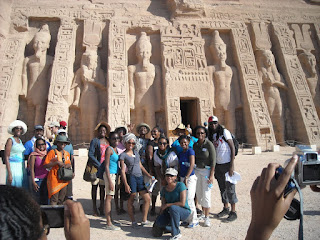
ng him something to return home to after fighting. The unifying concept of the Per-Uah restoring Ma’at has emerged as a constant theme as well, appearing in the well-documented efforts of Piankhy, Shabaka and
Taharqua mounted at the Nubian Museum of Aswan, which actually allows visitors to get "up close and personal" with the classical artifacts. (Angie and Brittany are pictured whispering
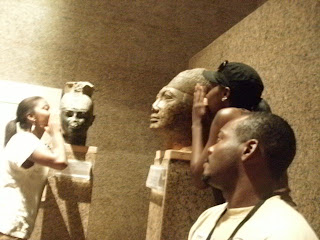
in the ears of Taharqua and Shabaka, respectively, as Robert lets us compare his face the latter Per Uah’s).
There are two reliefs in the back chamber of Nefertari’s temple, opposite the walls that framed her holy of holies. To the left, Ramses II worships his wife, with lotus flowers and Het-Heru behind him, sistrum in hand, coaching and urging him on. On the right, one of my favorite scenes, Het-Heru and Auset flanking Nefertari, breathing life into her. The royal epithet at the top of the first column of Mdw Ntr above Nefertari’s head, “Hemetch Nsw,” [King’s Wife]. The determinative for wife is a well full of water, the single most important element of creation and the thing that a human being—and a man needing a wife—cannot live without.
Friday morning, we had stood astride the Nile’s life-giving water on the bridge overlooking the Aswan High Dam. Looking downriver toward Abydos, Memphis, Saqqara and the Giza Plateau, we were reminded of the majesty and beauty of the land that thirty centuries of Black women and men had come together to create and share with the world. We surveyed the dry granite outcroppings that form the Nile’s final and northernmost of its six cataracts. Seized by the need for a mnemonic unguent, I scrolled through my Ipod’s playlist for a sufficiently powerful performance to lash the moment fast against the hard backbone of my mind’s long-term memory.
My eyes widened as the thumbwheel alit upon an Ancestral choice. I imagined Amenemhat, Ahmose, Hatchepsut, Piankhy and Ramses standing astride, along and upon the Nile, looking down the expanses of time and space and envisioning their successful efforts to realize Sma Tawi, Nsw Bity and Neb Tawi, the United Two Lands. As the dulcet harmonies of Lauryn Hill eased through my ears, the sudden turntable scratch emptied into the existential question that our children raise in the wake of perpetual challenges to their potential and doubts about their abilities, a question that evaporates when raised against the memory and vision of Kemetic serenity, permanence and relentless, unceasing movement: “Life…I wonder…Will it take me under?”
For fully three minutes, an eternity in hip hop timespace, I stood, motionless, before the Nile and the memory of the great African past, allowing Nasir Jones to resolve the seeming hopelessness of a puny and contemporary racescape against a hungry if as-yet underfed vision of what will and must be as he opined what he would do “If I Ruled the World.” His words and Lauryn’s melody catalyzed a comingling and bonding with my own mind’s eye as it played images of Pharaonic command and mass public effort, teeming all along the river’s four-thousand mile expanse over the three millennia of Kemet’s unbroken command.

“If I ruled the word/I’d free all my sons/Black diamonds and pearls/If I ruled the world…”

Our band seeps with contemplative deliberateness out of the busses and takes in each new site’s wonder: the steppes that frame the Tombs of the Nobles on Awsan’s west bank, including the tomb of Hardjuf, known as “the world’s first explorer” for his survey of inner Africa; the mirth of children in an Elephantine Island village that has been adopted by wave after wave of African-American visitors.

“Open they eyes to the lies/history’s told foul/but I’m as wise as the old owl/plus the gold child/seein things like I was controllin’/clique rollin’/truggers six digits on kicks and still holdin’/trips to Paris/I civilized every savage/give me one shot/I’ll turn trife life to lavish/political prisoners set free/stress free/no work release/purple jet skis/and M 3s…”

Saturday morning, as our little boat neared the island where the Philae Temple of Auset (Isis) has been preserved, we scanned the cliffs and foliage for the white birds whose craning necks indicated that we were looking at the descendants of Djehuty. The egret, of the ibis family were further proof that the people of Kemet were Africans. The symbols for intellectual work: the noble and silent baboon and the elegant, aloof ibis—were animals found only inside Africa, deeply beyond the reach or influence of Europe. The temple, built during the Late Period of Greek and Roman authority by Kemetic architects and designers, became the last temple where Kemetic spiritual systems were openly observed, by the Nubians. It was closed by the Roman Emperor Justinian, but not before Auset had transformed into Mary and written the “Cult of the Black Virgin” on the religious DNA of Christianity, from the re-inscribed portraits of Madonna and Child to the re-inscription of the largest single shrine to Isis in Western Europe to the Cathedral of Notre Dame (Our Lady) in Paris.

In the U.S., we have battled against the dim and vacant gaze of absence in the eyes and souls of children who have been pulled away from the excellent practice of study by distractions
real and imagined. As my mind’s eye framed image after image of our students drinking in inextricable sets of life-altering images, Nas and Lauryn’s declaration evoked the answer to the seemingly intractable question, “why?” They do not do better because they do not know. They have not seen. And, after all, we need not question what we would do if we ruled the world. In fact, the lessons of Kemet remind us that we rule the worlds our imagination and deliberate, excellent effort allow us to create.

Candid shots - Take 1

One of the great things about Summer Abroad (and there are many) is that I get to know students I wouldn't otherwise come in contact with, since I only teach graduate students and English majors. And I get to know them through this two week process in ways that I would never get to know them in a traditional classroom setting.

In a class in Locke Hall, I would never get to her Mariah singing as she walks down the hall.

I wouldn't know that Ernest is as thoughtful and gentlemanly as he is cool (as we exit or enter a boat, or a bus, or a door, he says "women and children first," jokingly, but he really does mean it, so he makes sure everyone is in; then he saunters along).


I wouldn't know that Angie is as much a genius on the computer as she is in the books. I want to be as smart as she is when I grow up!

Surely, I wouldn't have Brittany's stories (she has a wild imagination and can keep a straight face while she renders fiction as fact, and makes you believe she's telling the truth!). So, today when she told me there was a bat in the elevator, I thought she was kidding or exaggerating; she wasn't!


Clarice's personality would never come through fully in class. (Amid a long line of "I ready to..." (lay out by the pool, eat lunch, hang out in the lounge, get out of this heat), she says "I'm ready to learn," with such feigned enthusiasm that we all burst with laughter.


Spending 12-15 hours a day with someone for 2 weeks lets you see so many sides of a personality. In so many ways, they are already great people. Watching them grow is an added bonus.


So, as I'm getting to know them, I'm looking for moments & candid shots that speak to their personalities, sometimes after a tough hike up to a temple, sometimes after an emotional moment, sometimes after a hearty laugh (usually after Nijeul has let me have it or Toria has rendered a movie line word for word through two scenes).


Here are some candid shots... take 1.

Ernest, Dana, Nijeul, Maria, and Marcy...

Egypt day 1-4

I know ima lil late with this one but it has been sitting in my journal and im finally getting to post it.
This is only day 4, 8/6/09 and I am overwhelmed w/information and excitement. The process to digest all of the info is not a easy one. We start at 9:00 am and do not stop moving and learning until 10:00pm that night w/ breaks in between for traveling from site to site and eating. Even though it is rigorous the hands on approach to learning is well worth the trouble. From the mosque of the Great Mohammad Ali(not the boxer) to the site of the tombs of Ptah Hotep I can not find any words to explain what I saw. Colored hieroglyphics with pics of pharaohs, animals, and children is a sight that others have only read in books and heard in lectures. Heat, exhaustion and aggressive panhandlers can be small obstacles if you are not focused on receiving the full message. In this block of time i have been in Egypt i have learned a plethora of info and have a even greater appreciation for my people and ancestors.

Today is day 7...7 more days to go and i have to leave Egypt. Sad but true. Through this experience i have caught up with old friends and have met new ones along with mentors. When first arriving i thought i would not enjoy myself without being able to use my cell phone or being able to leave the house whenevr to hang with manz...it is trully the opposite. My ability to connect with the people of Egypt and to find myself is coming to be. I have found away to not to be so selfish (which i thought i wasn't) and to embrace someone else's culture and to find my roots within. On the other hand waking up at 2:30 and 5:30 every other day is truly a battle. The students and myself stay up late blogging /conversing with each other with Dr. Williams and Carr. So far this has been a great experience. By tha way we visited the Nubian Village which was cool because they were very welcoming and the children were full of energy even though it was baking outside. They are better than me. Anyway let me stop rappn yall up..its about time for dinner and this dude is hungry..ima keep yall updated on everything that happens.

P.S.
Shout out to Brydge Ent...

Dueces
Ernest C.

False Story

I was not negative
I have not ignored the obvious
I have not ignored those different than myself
I have not had a closed mind
I have taken adult responsibilites
I have not squandered opportunities

Check out our Photo Gallery

Lots of new pixs added. Check them out at www.coas.howard.edu/studyabroad/kemet/

Thanks Angie and Brittany for getting these to webmistress extraordinare Miriam Ahmed. Hotep Miriam!

Coming soon... videos!

Declaration of Innocence

The Declaration of Innocence

I have not envied my brothers and sisters
I have not taken from the rich or poor but have labored for my own bread
I have not neglected my duties as a child Of God
I have not hated but have loved every being made present in my life
I have not judged a soul but have prayed for every soul
I have not lived selfishly but have strived to serve humanity selflessly
I am pure, I am pure, I am pure!

My Search

It is 10:30 pm in Aswan, Egypt and I am sitting on the balcony of my room which overlooks the Nile Valley. There is so much peace in the air. As I look out, I see the full moon and a few stars scattered in the sky. My heart is content.
Words can’t begin to express how amazing these last few days in Egypt have been for me. In the last few days, I have seen “human creativity at its best.” Even now, I am still in a surreal state, my mind still can not phantom how these magnificent structures were built by the Egyptians
I think what has made this trip even more amazing is the conversations and discussions we have had. I remember two nights ago, a group of us sat outside in the hall way of our hotel; we began to discuss life and the order of things (Maat). We talked about religion, race and everything that made the world round. As we sat on the floor, I told my new friends that I was scared of this knowledge. In my entire life, I have lived in a box and believed my way of life was the only way of life. But what I have realized is that as one travels around the world, one realizes every culture is different and the ultimate truth is different in the eyes of every man.
I still have so many questions in my mind and my soul continues to search for my ultimate truth. Nonetheless, I would not change anything about my experience thus far
~Marcy~
"Be the Change you wish to see"

False Door Inscriptions

False Door Inscription

Though, I have struggled too often in this present life, never a day do I lose sight of my dreams
I remember the struggles and sacrifices of the man and woman who brought me into this life.
I will honor them until the end of life
I continue to search far and wide for the greater purpose of my life
I live to leave a legacy for my children and my children’s children.
I can only hope that I seize every moment in this life to fulfill the greater calling of my life
So says she whose name is Marcy

Saturday, August 8, 2009

In Search of Truth...

Reflecting on all the trials and tribulations that I had to endure to attend this trip, I have realized that it was all worth it. Initially, I simply wanted to go to Egypt to physically witness the accomplishments of Ancient Kemet; however, attending this trip has allowed me to question misconceptions that exist about and within our culture. What is blackness? Is straight hair an expression of whiteness? While thinking about the common answers to these questions, I realized that a lot of the answers to these questions are developed out of ignorance. Ignorance is truly bliss. I can go on forever about these notions, but I must digress… Abu Simbel was simply beautiful [laughs]. Although I did not appreciate a wake-up call at 2:30 AM, it was well worth it. It’s crazy to me because we have only been here for about a week and it feels like we have been here forever! Time doesn’t seem to exist anymore (not having a clock in any room contributes greatly)…especially because I never know what time or day it is. I am just so used to knowing what time it is (or even having a clock in the room). I must say, not knowing the time has definitely allowed me to cherish my experiences more. Anyway, I am feeling a little tired. Hotep

Yours in the Struggle,
Havian Nicholas

It's almost a whole week

We are almost finished our first week in Egypt and I have learned and experienced so much already. All of the sites are amazing. It’s crazy to think about how much work the Ancient Egyptians put into building the pyramids and temples. The amount of information on the Ancient Egyptians is so massive that I’m at a loss for words. The things that are most intriguing to me are their religious ideas and mythology. The Ancient Egyptian worldview is something that everyone should study. So far, this trip has encouraged me to apply some of their philosophies to my music studies and my life in general. This is so exciting but I am so tired..Goodnight..Wake up @ 7.

Mariah M. Maxwell

Week one almost complete...

I can’t believe I have been in Egypt for almost a week. It is mind blowing for me to look back on all we have done in just these 6 days. Ever since touching down at Cairo International Airport, we have spent every minute submerging ourselves into the history of Kemet. From the mosques to the pyramids to the tombs, I have witnessed so much history, but most importantly realizing that this is MY history. It is astonishing to see all these wondrous things but also know how they came about. Classes are so informative and I am fully prepared for what I will see the next day. Today at Abu-Simbel, I noticed how much we, as a class, are truly learning. We knew about Ramses and his battles. We knew the gods and goddesses depicted in the temples. We engage in stimulating conversions about what we get out of seeing all these great structures and writings. Never did I think I would be in an Egyptian tomb being able to read cartouches in hieroglyphs. I am loving every minute of this trip. I could not ask for a better group of people to be sharing this once-in-a-lifetime experience with. But as week one ends, it only makes me more excited about what is in store for week two!!

Clarice :]

Daughters of Rameses II

Saturday, and it hasn’t even been a whole week yet…Im currently riding on a bus back to Aswan from Abu Simbal. In Abu Simbal, we saw the temple of Rameses II and one of his wives, Nefertari. His statues were HUGE and the hieroglyphics were amazing. There was so much to see in the scenes inside of the temple, it was beautiful. The Egyptian people were so connected to God and their worlds revolved around their ideas of spirituality, and humility towards the Gods…. It makes me think about today’s Egyptians and how they associate themselves with being Middle Eastern, rather than black, African or Egyptians. Yesterday a man asked me if this was my first time in the Middle East, Is aid yes but I thought I was in Africa. Many Egyptians call themselves Middle Easterners. Evidently, it is a political statement. To be Middle Eastern is to be Muslin, being African is interpreted as something different. But Islam, as well as Judaism and Christianity draw many ideas from the traditional Ancient Egyptian religion. Therefore, it would seem as if it would give you more pride to say that you are Egyptian or African rather than Egyptian…Its interesting. Its like if I lived in Michigan but I associated myself with a traditional Canadian religion and therefore, I claimed to be Canadian, it seems wrong. In my opinion, Egyptians are experiencing an identity crisis because they don’t seem to know who they are. Our tour guide, Hala, said that Egyptian children today don’t learn about the ways of their ancestors or about how Egypt set the foundation of religion, mathematics, science, technology, English et cetera. Plato once said that what the Greeks are taught is fit for pigs and the Egyptian lessons are better. When will we as Africans, African Americans and Egyptians claim our ancestry and take pride in being the sons and daughters of dynamic Kings such as Rameses II???
Dana Daneeeeeeeeeee

TGIF

Peace!!!
I cant believe tomorrow is FRIDAYYYYYYYY. It feels like I have been on this trip for 3 weeks. We arrived in Aswan yesterday and are staying at this beautifulllllll hotel that sits on the Nile. I have to take a boat to get to town. Its absolutely amazing and is very different from Cairo. Cairo is like the big city, there are 80 million people that live there. Many of the living areas seem destitute and lower income. The children roam the streets and try to sell things such as bookmarkers and pictures for 5.5 pounds ($1.00). They get sooo frustrated when you do not want what they are selling. It makes you wonder what they have eaten that day… and the older people are worse. The bombard you at the tourist sites with tons of objects, and all they want is a US dollar. The level of poverty is soo apparent that it makes you wonder about the gap between the upper and lower class and what the government is doing to help its people. I believe, that there must be a small elite class in Cairo who benefit from the poverty of the masses, its sad. In ancient times, Cairo was a place were the Pharaoh, such as King Khufu, would work towards building a communal society where citizens worked together for a common goal and would receive shelter, clothes, and food to survive. This common goal was to build the pyramids in his honor and bask in its glory. These people depended on one another and this was the African way. Today, the influence of capitalism is apparent and the idea behind “every man for himself” seems to be the mentality of the people. This also obvious in the black community- long gone are the days where we can affirm that we “are our brothers and our sisters keeper”; long gone are the days were we sacrifice for the betterment of the entire community, not just ourselves. How can we restore the traditions of our ancestors?? Although Aswan is beautiful, it is the same as Cairo. I went to the market today and this man became clearly frustrated with me because I didn’t want t o buy the scarf that I had considered buying from him. It was enough that he doubled the price of its worth originally when he tried to sell it to me, but then he tried to cheat me out of my money when I decided to buy it. I gave him American dollars and he paid me back in Egyptian pounds but miscalculated what he owed me by more than 10.00, it was no mistake. This is the same man who said, “welcome home to Egypt” as I went past his shop. These people are so desperate for money. Anyway…I miss my mommy! Its soo frustrating that I cannot call the people that I want to call when I want to call them! It’s frustrating that I can’t use the compute when I want to, instead I have to wait in line, type a lil something something and then hurry off out of consideration of others. I don’t mind because everyone else has to do it but it has forced me to realize the amount of emphasis that I place on communication, and perhaps the lack of solitude that I sometimes need. Maybe the point is for me to focus on my experience silently and take it all in…
TTFN (Ta Ta for now)

Dana Racine Hall

PS- My daddy was feeling a little neglected so this shout out is for you!

The Temple of Rameses II

Leaving our hotel at 3:30 am, we took a small ferry across the Nile River to load our bus. With half opened eyes and dragging faces, we took our seats on the bus. Immediately taking our seats and overlooking the breakfast boxes prepared for us, we rode three hours to our destination.

Finally, after the sun began to rise, we arrived at the Temple of Rameses II. Slowly gazing up, we admired the gigantic statues of Rameses II located at the entrance of the temple. In amazement, we gradually walked into the temple.

More statues of Rameses II lined the center aisle on both the left and right sides. Deep within the temple, we saw a small room. With only the light from the sun shining through the entrance, we saw Rameses II sitting with the gods, Ta, Seth, and Ra Horakti. On two days out of the year, Rameses II’s birthday, February 21st and his Coronation day, October 22nd, the sun’s rays illuminate only him. This room, The Holy of Holy, was interesting. The intelligence of the Egyptians is one that we still haven’t grasped today, even with all the new technology emerging consistently.

The Difference

Evidently, prejudice permeates the sandstone edifice of each temple at Abu Simbel. Surprise is unwarranted, we have all surely encountered “the vile Foe” of Racism on the lesser plateau that we left last Sunday…but the spirit of Howard University that we have collectively and remotely recreated here has been audaciously challenged, and that is cause for an eyebrow raise.

We have stepped onto each site in Kemet, and our behavior in and interaction with these temples, tombs, pyramids, and monuments has shown brilliance in stark contrast to the demeanor of some who share the opportunity, as if their experience were shrouded in darkness…

We differ in purpose. In usual microcosmic HU fashion, we question what is placed before us because we know every notion is given through the lens of perspective. We are not simply on a tour; we are here seeking truth. We have studied, we have been listeners, and now we are becoming our own interpreters. We don’t simply pose & snap photos & marvel at the aesthetics of our surroundings. We interact with the space we enter. We study it: study the structure, learn and study the mdw ntr (glyphs), study the light, study the sound, through conversation, explanation, inquiry, and discussion while on site.

We ask what the symbols mean. We ask whose name is inside the shenu (cartouche). We ask how the temple architects constructed the temple of Heru (Horus) in order to cause sunlight to illuminate only the likeness of Ramesses II on his birthday and “coronation day.” Not all questions are answered, but questions are asked, and discussions are had. We don’t simply observe the site; we interact with it. We don’t even have the time or desire to notice the other tourists or the guards, thereby leaving a potentially reciprocal relationship irreconcilable.

Today was the first day that I became aware of the threat we pose to them. It may have been the guards’ insistence on following our group in order to force the “No Cameras” rule while other tourists snapped away, flash and all, at the temple walls that made me see it. Or perhaps it was the European tourist who stamped and cursed her way out of the temple of Het-heru after we were allowed to stay despite Dr. Carr guiding us (we, thus, became an exception of the “No Guides” rule). Or maybe it was even the European man at our hotel when, seeing us relax in the pool, asked, “What are you wild ladies doing in a place like this?” and if we have a connection to Egypt.

See, to them and most of the world, we don’t belong here in Kemet. This place is not ours to claim: Kemet is not Africa. It’s ancient people were not African. So why are you rowdy African Americans here? What is the American Negro doing in Egypt reading glyphs on the walls? Step aside for the Italian, Spanish, English, Asian, and (white) American tourists. And Why do they refer to Cheops as Khufu, and Memphis as Mennefer, and Egypt as Kemet anyway?...
…Because we’ve looked into Pepy’s face, Seti’s face, Ramesses’ face; we’ve seen their skin; we’ve seen the statues and reliefs of Montuhotep, Khufu, and Khafre to Tiye and Akenaten; we’ve read Diop & Obenga & Carruthers; we’ve seen how the people of Kemet depicted themselves, down to the paint color, and how they depicted foreighners; we know that the Kemetic people, in their late period, viewed the Greeks as “childlike;” we know that several modern African civilizations trace their origins to Kemet; We know that chemistry, the alphabet, math, architecture, astronomy, literature, medicine, modern religion are all owed to the people of Ancient Kemet.

That is why we are in this place. We are connecting with our history…and to be unwelcome, to be followed like shoplifting teens, is like being chaperoned on a visit to the graveyard of our relatives. We are here at the resting place, the living space of our ancestors, and we face what their history has faced: greed, distortion, and misunderstanding.

As we look into the faces of their monuments, they hold their gaze steadfast on the rising sun, as if to say, “Patience. Maat is. The time will come.” And we continue to learn, we continue to teach, we continue to be inspired, energized, and motivated by this place. We take in its air through our noses like the gift of life, like the ankh…and we continue on.

-Ang

Live from Aswan

We arrived in Aswan 4 long days ago. Our first full day here was a full class day, so everyone worked on their false door inscriptions, their declarations of innocence, and their commentary on our first two themes—the politics of translation and the eloquence of the scribes. You can see many of the students’ responses to the themes and their narratives on some of the blog entries above and on the main website. We’re working on about 9 laptops, so it’s community learning and community sharing at their finest. After Angie set up folders on a flash drive (that thing’s going to be worth millions with all the video footage, pictures, audio, and narrative commentary!) so we could do a big dump of our day by day with subfolders for site by site and subfolders of the subfolders, we were running like a well-oiled machine… like, hmmmm, ancient Kemetic peoples building a pyramid. One group worked on labeling the pictures, another group worked on editing video (Jazelle is queen!), Brittany made sure we had the right audio… It was amazing. We were supposed to work from 10-1, break for lunch for an hour, then get at it again from 2-5. But once they got rolling, I don’t think anyone took a break, except to snack and to direct traffic. It wasn’t until 2ish that we had the “slowskies” (remember the Verizon FIOS commercials!) break our rhythm. We had over 100 images per site, and by the time I went through the all to pick the clearest shots of each site, we still had about 100 per day. It took over 10 minutes to upload a few images, and our internet card ran out! So much for the master plan. But by then, the work had been done. Our challenge now is to get it uploaded. Hopefully, shortly after you read this, some of it will be up.

We’re on the bus from Abu Simbel, and we have mobile wireless access, so even our 3 hour ride is work filled. Now that everyone sees how much there is to do and how little time there is to do it, everyone is managing his or her time so wisely. While we’re riding, some folks are typing and writing their blogs to be posted later. Hola, our guide is doing a Q&A. We’re passing up memory cards and downloading to folders…. The pyramid building continues.

Yesterday, we went to the temple of Philae. I suppose it’s still on the tour site for everyone because it shows the Greco-Roman presence and the early Christian presence in Egypt. What we noticed especially was that the use of glyphs here had more to do with ornamentation, or filling space than with their more traditional purposes. After Philae, we went to the High Dam or the Dam Dam. We could appreciate the civil engineering, but mainly, we looked over toward the Sudan. After the High Dam, we went to see the unfinished obelisk at the rock quarries. The granite there is absolutely amazing. But it’s natural, so I suppose you don’t have to be fascinated with that. But you must be fascinated with the imaginative genius of carving the rock to create free-standing structures. I can’t wait for the students to see the obelisks in Luxor since the one they saw was still in the ground because it cracked and was abandoned. When they see there are so many obelisks and that they are everywhere, they’ll never see the Washington Monument in DC the same way. It, then, becomes “unfinished.”

Today, we went to Abu Simbel, where we saw sandstone rock temples of Ramses II and his wife Nefatari. Since we went through the Battle of Kadesh in lecture yesterday, they were looking especially for scenes from that battle narrative where Ramses claims to have defeated the Hittites and all of his other enemy’s all by himself! Today was one of those days when they were so knowledgeable about what to expect, so we were able to get the most out of the visit. Only harassment by the guards, who allowed our fairer brothers and sisters to take pictures but literally followed us around the entire time, proved an unworthy distraction.

Since most of the tourists are overwhelmingly white, we stand out, to the guards and to other black people. So, they gravitate towards us and listen in on our talks about is being portrayed. Today, we ran into a woman named Catherine, who was from Philly. When I noted that Dr Carr lived in Philly but was from Nashville, she said she was from Nashville too. Small world! Reminded me of the time we were in South Africa and a black guy recognized our accents, asked us where we were from (he was from Oakland), and then told me that there was a lady from my hometown on the same boat we were on (to Robben Island) from Tallulah. Get out!

Thursday, August 6, 2009

Education and Institutional Memory

"This writing was copied out anew by his majesty in the House of his father Ptah-South-of-his-Wall, for his majesty found it to be a work of the ancestors which was worm-eaten, so that it could not be understood from beginning t
o end. His majesty copied it anew so that it might become better than it had been before, in order that his name might endur
e and his monument last in the House of his father Ptah-South-of-his-Wall throughout eternity, as a work done by the son of Re, Shabaka, for his father Ptah-Tatenen, so that he might live forever."

--Preface to The Memphite Theology on the order of Shabaka, Per Uah of the 25th Kemetic Dynasty, 710 b.c.e.

"Cherish study, avoid the dance, so you'll become an excellent official. Do not yearn after outdoor pleasures, hunting and fishing; shun boomerang throwing and the chase. Write diligently by day; recite at night. Let your friends be the papyrus roll and the scribal palette; such work is sweeter than wine. Indeed writing, for one who knows it, is far better than all other professions, pleasanter than bread and beer, more delightful than clothes and perfumed ointments, more precious than a legacy in Kemet, than a tomb in the West."

--Neb-Maa-Re Nakht, Royal Scribe (Sesh Nesw), 20th Kemetic Dynasty, c. 1500 b.c.e.

The legendary W.E.B. DuBois was known for his passionate moderation. In bed daily by eleven p.m. A remarkably disciplined reader and writer who planned research agendas with daily tasks over years and kept to them with low tolerance for interruption. A literal human metronome of consistency and intellectual productivity.

In writing about the Reconstruction period in U.S. history, Dr. DuBois captured a strikingly similar combination of intellectual passion, consistency and productivity as he marked the determination of "an entire race" to go to school in the wake of the end of the U.S. Civil War. As Mary Bethune would remark before Congress in 1939, within several generations, a people who had been pressed into functional illiteracy in the reading and writing of the English language had produced generations of students who had mastered the language and set out to dismantle the system that had required their miseducation. Ms. Bethune and Dr. DuBois (pictured here in the famous 1936 photograph taken on the steps of Frederi
ck Douglass Hall with Adelaide Cromwell, Monroe Work, Charles Wesley, James Weldon Johnson, Alain Locke, Arturo Schomburg and Mordecai Wyatt Johnson, among others as they worked on the landmark Encyclopedia of the Negro) were only two among the ranks of pioneering scholar-educators who traced the institutional memory of the African quest for education in the United States.
As we engaged in line for line readings and translations of two of the most famous texts in Kemetic literature, the considera
tion of the origins of reality in the so-called Memphite Theology and a mediatio
n on the field and functionof intellectual life as distinct from all other field of labor entitled The Instructions of Dua-Khety (more commonly known as The Satire of the Trades), our students opened a deep and energized consideration of the fact that the African-American quest for education has its roots in the dawn of the human experience.

At the center of Africana intellectual work is respect for the process of reading and writing and the determination to provide methods for collective learning. The notion of the group "learning community" has its origins in
Kemet. From the Kemetic sites of scholarly instruction (known as the "Per Ankh" or "House of Life") to evidence of scholarly achievement ranging from the step pyramid (shown here behind Jazelle Hunt) and the stone structures of Imhotep that enclose it through the great convenings of scholars trained in Arabic, Songhai and other scripts at the great centers of learning at Timbuktu and Jenne in the 16th and 17th centuries; straight through the rites of intergenerational learning in Western and Eastern Africa that inspired Lord Baden-Powell to return to England and found The Explorers (t
he model for the subsequent Boy and Girl Scouts); to the collective struggle of Africans to retain the high skills and crafts of their home societies and to learn enough of each other's languages and skills to survive and resist enslavement while ship-bound; through the genius of their descendants to inherit those cultural markers and to pour them into educational institutions called Abakua, Poro and Maroon or Mason, Order of Eastern Star and Mutual Aid and Relief Society.

The Historically Black College and University has inherited these Maroon sensibilities and the traditions of communal, collective learning that they represent. In the U.S., schools began to convene in hush harbors and one room cabins, far different than the imposing stone structures we have borne witness to so far in Kemet. Yet some things have remained the same: the determination to right that which is wrong; to rebuild anew, better than before
. To shape the future in ways that respect the contributions of the past in ways that do not deify the ancestors while listening to the wisdom that their experiences provide.

Today, we set forth for the temples preserved on the Island of Philae. When next we blog, I hope to continue this discussion of how the texts we have begun to consider in great detail capture the tone and tenor of Africana approaches to intellectual work.

The Journey Continues: Day 6

We arrived in Aswan yesterday, the land of the Nubians, in Southern Egypt. Our hotel sits on an island on the Nile River and in the morning we can see the sunrise in the east and set in the west. This can attest to an array of Nubian contributions to the society from several different disciplines of thought. Just the sun’s rising and setting is a peaceful, self-awareness aura. Today’s discussions lead us to dissect the literary work Satire of the Trades. Found in the time of the Middle Kingdom, this satirical literary piece speaks to the education of children. It appears as though an elder or father is teaching their young child the importance of taking up the profession of a scribe and not settling for the work of a common man. In this case, I interpret the profession of the scribe as not only a writer, but a historian of the people. In relation to African-American culture, I feel as though there needs to be a revolution created for documenting the history of our people; and in particular, through the arts. The work of August Wilson, African-American playwright, documented, in a theatrical, yet historical way, the history of African-Americans over the past ten decades. His work is a true representation of the ‘scribe of today’. Even the work of this blog is a documenting tool that will last for generations to come. The piece says:

“See, there’s no profession without a boss,
Except for the scribe; he is the boss.
Hence If you know writing,
It will do better for you
Than those professions I’ve set before you,
Each more wretched than the other.”

As a writer you are in control of yourself. I think writing allows you to connect to a larger prospective of the world we live in, and more specifically, the culture you are conserving. When I was younger, my mother collected pictures, programs, and several memorabilia that document our growth from birth to about 8 years old. The question becomes, what happened to that documented information for the 13 years after that? If we don’t document our history…who will?